What Fires Together, Wires Together

What Fires Together, Wires Together

The human brain functions primarily on the basis of pattern recognition. This is a really important idea in this discussion so let me say that again: the human brain functions primarily on the basis of pattern recognition.   Learning is fundamentally a neurologic activity where patterns of data are stored in the relationships of neurons folded over one another in what one brilliant neurologist refers to as neural origami.

Your brain stores data in the context of patterns and those “patterns” are stored in an interwoven network of neurons. The human brain starts learning patterns from the minute it is introduced into the external world. Another important fact to remember is that the human brain learns in the context of what it already knows.


For instance, the brain of an infant takes a “snapshot” of the ball in it’s hand. They see the shape (they don’t yet know that it’s a sphere), they see the color (which they don’t yet understand is the pattern for “red”) and they throw this onto the floor and to their delight it bounces! What do they do next? They begin to test hypotheses. Anything that is “red” goes over the side of the crib to see it if will “bounce.” Anything that is a sphere goes over the side to see if it will bounce. When it does, they are delighted and the origami in their brain for balls (or objects that bounce when thrown) is unfolded and the data stored within is expanded to include things that are yellow, green or blue. The brain has developed expertise in recognition of the pattern of spherical objects that bounce when thrown, which we call balls.

The simple process that governs the creation of neural origami is the idea that neurons that fire together, wire together. That is to say that the human brain builds a relationship between neurons that are excited at the same time. The child described above may recognize the visual input that represents “red.” The child may recognize the visual input that represents “sphere.” When the object is dropped, the neurons in the portion of the brain that processes spatial relationships may excite and the child now has a network that integrates all three concepts. That network is expanded each time a spherical object of whatever color demonstrates with the spatial experience of bouncing.

Henry David Thoreau once wrote that, “As a single footstep will not make a path on the earth, so a single thought will not make a pathway in the mind. To make a deep physical path, we walk again and again. To make a deep mental path, we must think over and over the kind of thoughts we wish to dominate our lives.”

So it is with neural origami. The glue that holds these “networks” of neurons together is the concept called long-term potentiation. Long-term potentiation is the strengthening of the relationships between individual neurons as they repeatedly fire together. Neurons that fire together, wire together and long-term potentiation makes them stick: the greater the frequency with which a group of neurons fire together, the greater the strength of the “folds” among them.


Thirty Watts of Computing Power

The amygdala processes an incomprehensible amount of sensory data. While it is impossible to accurately assess the scope of data processing that occurs in the amygdala itself (at least to my knowledge), it is estimated that the human brain processes an extraordinary amount of data each second – somewhere in the realm of twenty million billion pieces of data processed each second.

Here’s the math:

  • The human brain supports roughly 100 billion neurons.
  • A single neuron fires approximately 200 times per second.
  • Each individual neuron is connected to approximately 1,000 other neurons.

When one neuron processes information, the neurons it is connected to fire as well.

  • 100 billion neurons X 200 firing/second X 1000 connections =
  • 20 million billion pieces of data being processed by the human brain each second.

That’s a lot of details!

Every activity that occurs in the human body is a reflection of neural activity.

It is reasonable to say that the amygdala is involved in a fair part of this processing. While the total volume of data processing includes conscious thought (what will I have for lunch today, what is the best way home tonight, etc.) – this data includes a spectrum of sensory data – what you are seeing, hearing, tasting and touching. It includes feedback from your body about the temperature, the position of your body, your movement, degree of physical discomfort, etc.   Most of this processing – in reality more than 99% of this processing – is done subconsciously without you being aware of it. In fact, it is suggested that your brain is only “conscious” of 2,000 – 8,000 bits of the 20 million billion bits of information that it processes each second.

Why are we not aware of all the data all the time? Well, unfortunately, the human brain hasunknown-4 limited bandwidth.

The human brain – regardless of whose brain it is – only possesses about 30 watts of processing power in any given moment. That means that the energy in your brain available to problem solving at any given moment is roughly comparable to the energy required to illuminate the light bulb in your refrigerator. This is the total available bandwidth a human has to orchestrate the management of stimulus from moment to moment. This is the maximum bandwidth available for decision making, navigating your environment and engaging with the other humans around you: thirty watts of computing power. This is what neuroscience researchers often refer to as “working memory.”

Working memory is the part of our reality that we are aware of in this minute. Working memory allows us to make sense of what is happening around us as we experience it. Working memory is what gives us the capacity to have a conversation or debate, pulling facts and concepts relevant to the topic at hand from our long-term memory.

To reference computing once again, when we purchase most personal computers we are presented with information about the amount of available RAM (random access memory) each machine possesses. The RAM determines the available computing bandwidth on a PC or laptop. It is the limiting factor in how effectively the computer will work in its processing capacity. It does not matter how much storage capacity the computer has, or even the processing speed, the limiting factor in the computer’s performance is the space available for processing in any given moment. If the computer is asked to process too much information at one time, the computer will crash. The same applies to the human brain.

Consider for a moment how many times you have been involved in one activity, became distracted and completely lost the information your brain was just working on? Or, you were involved in one activity that requires a great deal of concentration and became irritable when someone turned on the radio or increased the volume of background noise? My personal favorite is walking from one room to another and completely forgetting what I came into the second room for because something else distracted me. These cases are examples of exceeding the brain’s available processing bandwidth.

To accommodate this limitation on the brain’s processing capabilities, the human brain learns to prioritize sensory input. The amygdala – the emotional center of the brain – plays a crucial role in this prioritizing and integration process. The amygdala – and all the emotions associated with it – including fear – is the core structure for the integration of various sensory input into learning.

Prioritizing sensory input is the evolution of expertise in the art of living and it begins the minute we start breathing. There is data to support that infants begin to recognize faces within 45 minutes of birth. From within minutes of its arrival in the realm of the living, the human amygdala begins to rapidly make sense of its environment; it prioritizes data, it begins to learn about patterns.

Any thoughts as to why a blog on addiction might include comments about how the brain prioritizes data and builds patterns?  I’d love to hear your thoughts.


Mission Control…


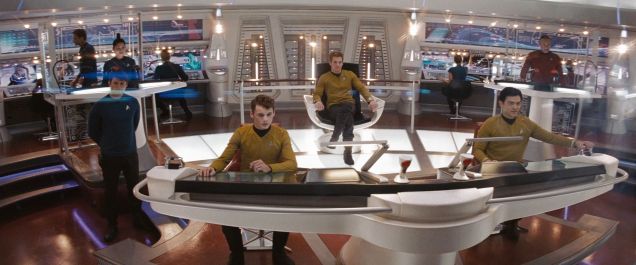
Visualize the images of “mission control” that you might have seen as part of any space shuttle launches or a scene from the movie Apollo 13. Another good image to conjure would be the “bridge” from the starship Enterprise in Star Trek. uss_enterprise_alternate_reality_bridgeIn each of these images you have a similar underlying idea of a location where a massive amount of “sensory” data flows into a command center. Advanced technology and highly skilled resources review every bit of data that is possible to capture, scanning the data stream for any anomalies or patterns. Once something “blips,” attention is immediately focused on that aberration and a reaction is mounted:

“Captain, they’re raising their shields!”

What happens next is immediate: “Red Alert”

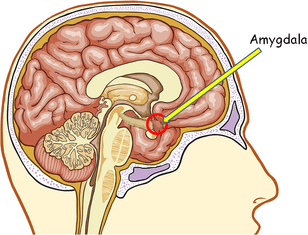
There is a structure in the human brain called the amygdala. It is part of what is known as the limbic system. The amygdala is located in the temporal lobe of the brain – in close proximity to the brain stem.

_4755829
Source: brainmadesimple.com

There are some who refer to the amygdala as the fear center of the brain; it is considered by others to be the emotion-processing center of the brain. I like to consider the amygdala “mission control” or, maybe more accurately, a “strategic command center.”


It is the amygdala that signals “Red Alert” in the brain. The amygdala is the emergency management system in the brain using to separate pathways of response. The amygdala is the initial, immediate, instantaneous response to anomaly.

There is also a data stream to the amygdala’s mission control that links through the sensory cortex of the brain. This secondary data stream provides the problem-solving associated with the “red alert.”

To give some context to how the amygdala processes and responds to the data that streams through it, let’s talk about a walk I took through a nature park near my home. It was a balmy late-summer day. Beautiful clear skies and roughly eighty degrees – it was a perfect day for a walk on the asphalt path of the park.

As I was strolling through the path, enjoying the beauty of the gorgeous day, my attention suddenly snapped to an object that had been laying on the edge of the path as it began to stretch itself out across the width of the path.   My immediate reaction was to stop. It took a millisecond or two longer for my brain to grasp that it wasn’t a stick that was moving, it was a snake! I took an instinctive step backwards away from the snake as I was observing how long it was before I remembered that I live in a part of the world where few poisonous snakes are found outside zoos and pet stores. I then took a step closer to see if I could capture a picture of the reptile with my cellphone because I didn’t recall that garter snakes could grow to three feet in length.

My amygdala was responsible for the immediate snap of my attention to the unexpected movement on the side of the path, the immediate stop and my step backwards: Whoa – stop – safe distance!

The curiosity and inquisitive action that occurred once my initial startle had passed reflected that my amygdala had moved from the immediate “survival” response into processing through the sensory cortex which transformed my initial surprise into an investigative process. “What is that?”

Another good example of this blended pathway of sensory processing would be an adult’s response to a loud noise. An explosion occurs, your amygdala has you “jumping” and turning your head in the direction of the sound before your eyes, ears, and nose are reporting that the car next to you backfired.

The amygdala generates the “Houston, we have a problem” response. The sensory cortex pathway brings forth the investigative team: what was that? What direction did it come from? Have we seen this before? Who is involved? Etc.

All incoming stimulus – visual, auditory, tactile, spatial – is processed through the amygdala. There is a constant stream of data flowing through – even when you are not conscious of it. In all truth, the amygdala is reviewing this stream of data particularly when you are not conscious of it.

Is anyone reading this asking themselves why I would be including this information in a blog about addiction and recovery?  I’d love to hear your thoughts…

Meet Magellan…

Last Friday, I was sailing with a friend in the middle of the Long Island Sound.  I looked down to find a grasshopper exploring the roof of the cabin on my sailboat.  Sunday I was sailing again – once again in the middle of the Sound easily three miles from shore. As I IMG_0608was sitting by the tiller, I happened to look to my left and came eye to eye with a different grasshopper!
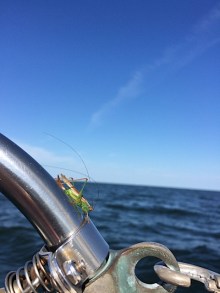
Meet my new friend Magellan.

My response to this close encounter was to laugh (after I got over my initial shock at having this creature so close to my face).  And then I began looking for God as coincidences in my life usually let me know that my Higher Power is present.  I’ve owned this boat for over a decade, having one grasshopper aboard was noteworthy – having two in three days was unprecedented.

So Magellan remained with me for the remainder of the day on Sunday – about three hours of sailing.  He quite happily maintained his position on the rail with his antennae flowing in the westerly breeze.  As I moored the boat in the harbor, I carried on a conversation with him extolling the virtues of the foliage surrounding us and wishing him joy for wherever his travels would take him. And I got off the boat.

I returned to the boat on Monday to enjoy my lunch in the glorious weather.  I climbed aboard and got the cushions all comfy for my meal and some meditation.  When I happened to look up and I found myself once again eye to eye with Magellan.  He had made his way around the cockpit and was now perched on the teak rails of the cabin.

Now I am really intrigued.  Not only was a grasshopper on the boat, it was the same creature as the day before – this is getting interesting.  I greeted him and let him know that I was concerned for his health as I was now wondering if he might have flown into the sails the day before and injured himself.

I settled on one of the cockpit benches to meditate.  I opened up an app I use, started the guided meditation and closed my eyes concentrating on the meditation and the movement of the boat.

A horn sounded.  My eyes snapped open and I had the pleasure of watching Magellan walking his way across the roof of the cabin toward my phone that was playing meditation music.  I turned the sound off, the grasshopper stopped moving.  Ok, now we’re in really strange territory!

While all this was unfolding, the thought that kept circling around in my head was, “Is it odd or is it God?” But I couldn’t immediately see the message.  I sent a friend a text with Magellan’s picture and she helpfully provided a link about the grasshopper totem and what it might mean.  I read the information:  patience, prosperity, perseverance.  Okay, I get it but why now?  Why today?

As I was reflecting on this creature  and why he had been dropped into my life it dawned on me that he might be legitimately injured, hence his prolonged visit on my boat.  That left me with the dilemma of what to do next.  I certainly wasn’t going to jump into codependency, grab a cup and bring him home.  But at the same time I was uncomfortable just leaving him.

Being me, I jumped on the internet to determine what grasshoppers actually eat (okay – I’m not taking him home but I’m also not leaving him to starve if he is injured!)  I was quite pleased to learn that any plant-based carbohydrate might appeal.  I just happened to have a bunch of grapes in my bag.  Feeling absolutely ridiculous that I was worried about the health and welfare of this grasshopper, I bit a few grapes in half and strategically located them within antenna distance of Magellan.
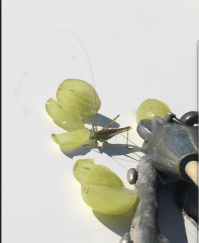
Screen Shot 2016-09-01 at 5.31.21 PMTo my surprise and glee, Magellan walked over and began to eat.  I sat there watching as his antennae blew rhythmically in the wind.  He investigated each broken grape, nibbled a bite or two and moved to the next.  And that is when the lesson hit me directly between the eyes.  Here was yet another metaphor for recovery.

When I started the process of recovery, I was adrift in an ocean of my drugs of choice.  Literally – quite literally – drowning in my addiction and the bad choices that arose from it.

And much like my friend Magellan, by God’s grace alone, I found myself on the boat called love, sailing in the direction of the safe harbor of unconditional love and acceptance – a place I had never been before.  On that first leg of my journey, I relied on the skills and wisdom of others for navigation.  I had no clue where I was going or much less how to get there, but I was carried by my home groups until I could carry myself.

But even in a safe harbor, life isn’t simple or straightforward – challenging things happen – people die, we lose our jobs, we are unexpectedly injured, our bodies age.  Even when we are on the boat called love, difficulties arise that challenge us, our ability to cope and our recoveries.  In sailing terms, life can be smooth sailing until a ferry leaves a wake immediately adjacent to the boat – everything rocks, stuff falls everywhere and you have to hold on so you don’t fall too.

During those hard times, when we can’t figure out what to do, when we’re injured and can’t do for ourselves, when those waves of change have rocked every part of our lives and seem particularly hard to navigate and downright unfair, it is easy to question our faith and to wonder if God truly loves us.  Those dry periods where everything is rocking, we can’t see the path through and it feels like God has abandoned us can be some of the most difficult times of recovery.

And then, one day, boom, out of nowhere, in an environment where it is wholly unexpected, grapes appear.  My needs are taken care of in ways that I simply couldn’t imagine (I mean really, do you think any self-respecting grasshopper would be expecting grapes to drop out of the sky in the middle of a harbor?).  Literally, manna from heaven arrives in my life.

So this little grasshopper became the guru for me earlier this week.  His presence in my day led me to being reminded of a powerful lesson about patience with God.  He served as a potent reminder from my Higher Power.

I had been journaling that morning about the discomfort of living in the “space between the miracles.”  The space between the miracles are those points in recovery where change isn’t happening (or happening fast enough for me !), when I don’t have the clarity I feel I need, or when the struggle for growth is overwhelming and feels like it will last forever.  In my mind, the God of my Understanding sent Magellan to remind me that grapes are on their way in my life, that I can’t predict amazing and that gratitude for where I am and a willingness to just show up in faith will lead me to them.

The Survival Machine

So, why did I reference the concept of the various ages of the human brain and potentially how the brain developed in my last post?   The discussion of why the brain works, and to some degree how certain parts of the brain work, is important to truly understanding addiction and recovery as processes of learned behavior.[1]

I think, that as a society, as a culture, as an evolved species with an impressive capacity to think and consider abstract concepts, we lose sight of the fact that the human brain was not originally designed to “think”, at least not in the context of how we might consider the action of “thinking” today. The oldest parts of our brains originally evolved to act instinctively in order to keep the organism alive. Our brain is, in the words of James Zull, “a survival machine.”

Today we live in our highly evolved glory surrounded by a robust social safety net that includes abundant resources for nutrition. Our lives in the United States include a great deal of technology to keep us safe from the threats that our ancestors faced on a daily basis: vaccines to keep us healthy, animal control to keep predators at bay, heated homes to protect us from the elements. We lose sight of the fact that everything about our brain evolved on the basis of managing threat or danger and experiencing things that sustained the species (and generated pleasure).

It is easy to understand the necessity of the “fear center” in your brain when you consider the conditions that most humans have lived in. If you look back beyond the aberration of the last 120 years, the ability to recognize a threat and instantaneously respond to it with movement and problem-solving served us well when, as a species, we were dancing with lions and tigers and bears all day. During our days filled with higher order thinking (hmmm… what will I order as take-out tonight?) it is very easy to lose conscious awareness of how important and powerful the fear and threat management mechanisms in our brains really are.

Our first breaths were taken not because we thought and made the choice to breathe. Our first breaths were taken because certain structures deep in our brains responded to external stimulus and impelled us to do so.

Let’s take the survival mechanisms of the human brain out for a test drive. Let’s demonstrate how the survival pathways in our brain trump the power of conscious thought.

Take a deep breath and hold it.Unknown-2

Repeat the following thought in your mind:

“I am not going to breathe, I am not going to breathe.”

Wait thirty seconds. Wait 45 seconds. What happens?

Your chest begins to feel a little tight; your body begins to tense. If you hold your breath long enough your face will flush, you will begin to sweat and all of sudden, against your will, you will exhale.

Why?

Because those “unconscious” survival pathways of your brain are doing their job – they are keeping you alive – regardless of what you are thinking.

If you continue to resist, what happens? Your body shuts down unnecessary processing – like conscious thought – you lose consciousness and your body returns to “normal” breathing. Such is the power of the threat management strategies of the human brain and body.

Each day hundreds of thousands of “invisible” biochemical processes occur in your brain – all designed to keep you alive and the species evolving. Breathing; eating; moving; turning your head toward an unexpected sound; ducking your head when something falls off a shelf – all seemingly “unconscious” processes that occur over and over with little, if any, “thought” on your part. All processes designed to keep the organism that is you alive and functioning for one more day without you consciously thinking about it.

How do you think this might be related to the disease of addiction?  I’d love to hear your comments.

**********

Zull, J. (2002). The Art of Changing the Brain. Sterling, VA: Stylus Publishing

**********

[1] N.B. Throughout my posts, I reference certain processes or functions of areas of the human brain. My goal here is to explain what is relevant about brain functionality and evolution, not to spend a great deal of time on the how of brain function. There are a number of useful resources that explain how the brain works (for instance, McGill University has a wonderful resource online about brain structures and how they interact).

Very Old Technology

So, let’s start with a question: Exactly how old are you? Early 30’s? Early 70’s? Somewhere in between?

My answer to this question is a little different. In my understanding, “you” are at minimum tens of thousands if not somewhere in the realm of hundreds of millions of years old. That is when the nature and structure of the core processors of your brain were developed. That is when the “technology” – the basic operating system that supports “you” – was initially coded.

While I would love to tell you that you are unique and different and the latest release of this incredible wetware, the unfortunate reality is that your brain – and the brain of everyone standing around you – runs on release 1.0 of the Reptile operating system developed before there was code.

I happen to be a dinosaur. I had the privilege of using computers when the idea of a personal computer (PC) was first commercialized in the late 1980s and early 1990s. At the time, MS-DOS (an acronym for Microsoft Disk Operating System) was the prevailing operating system for most PCs. This operating system was the basis for main-stream personal computing for over a decade (the Microsoft Windows systems was a hybrid of this system until the Millennial Edition).

A disk operating system is basically group of rules and processes that govern how information is accessed and stored on a computer. The traffic laws that govern commuter traffic could be considered an analogy for it. There are rules for how cars can get on and off the highway, where they can park, how fast they can move and how many can be moving at once. The disk operating system governed how data could move and was stored on early computers.

So, way back in the day, software architects would develop computer programs using this underlying, basic computer operating system, a basic set of rules for the management of data. Because the basic operating system was initially effective in meeting certain fundamental computing needs, as new programs were developed the existing effective processes were added to and expanded on instead of being replaced. Developers would create programs with advanced features and functionality using the basic DOS operating system as the underlying computer platform. Release after release (meaning Windows 3.1, Windows 95, Windows 98, etc.) offered incrementally increasing functionality and flexibility while all using some version of MS-DOS as the underlying computing strategy.

Much like the evolution of computing technology, so occurred the evolution of human grey matter over many millennia. It is suggested by some scientists that the “human brain” has doubled in size over the course of the last 7 million years. Much of this growth has occurred over the last 2 million years. This growth included the addition of new structures that function on an ancient base.

The brain stem is the oldest part of the human brain – it is what is sometimes referred to as the “reptilian” part of the human brain. It controls the basic operating of the human body – breathing, circulation, balance, vision and hearing. The brain stem represents the basic operating system of the human brain. As humans developed higher order reasoning capacity, the additional structures of the brain did not recreate the basic operating system, but instead developed more sophisticated features using the functioning of the brain stem as a platform.

Like the evolutionary process supporting the development of PCs, where the original operating rules remain consistent release after release with more sophisticated applications being developed on top of them, so too did human grey matter evolve around the basic functionality of the brain stem. In effect, the higher-level cognitive function that occurs in the frontal cortex of the human brain is operating on the computing equivalent of pre-historic DOS 1.0. Additional functioning capacity did not rewrite the underlying human operating system, but instead learned how to leverage it into higher-order thinking.

The limbic system – the brain structures that govern emotions and judgment -evolved next. The human brain stem and the limbic system – the fear and pleasure centers that are immediately adjacent to it in your brain – play a crucial role in human decision-making. And like much of the “early” technology created to power our computers, the underlying operating system that supports what we believe to be our higher order thinking, is not particularly accurate, has limited processing capability and, if you’ll forgive the computing pun, is rather basic in spite of its elegant complexity.

A lesson from an osprey…

Last week while I was sailing, I had the privilege of watching a family of ospreys.  There images-4were five birds all together – each making lazy circles in the sky above my sailboat.  It was pretty clear to me that “Mom” and “Dad” had the kids out for a fishing lesson.  “Mom” – an osprey with a massive wingspan – slowly circled the group, “whistling” to the other birds.
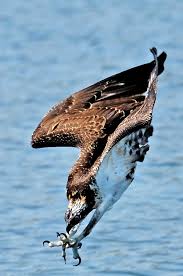

Mom’s aspect changed.  She seemed as if she were hovering in the air, almost stalled.  Suddenly, she began a rapid dive toward the harbor.  Wings back, intent on her target.  images-5

There was no fear about the plunge into the water at full speed.  There was no deviation from her path.  At the last minute, her talons moved forward and into the water she went, feet first.

Second later, she rose from the water – a fish firmly grasped in her talons – slowly, rhythmically ascending with her prize.

So, why am I writing this here?  For me this is an epic metaphor for how the 12 steps work.  We see people circling around the rooms – literally, circling.  In and out, in and out, watching as other people’s lives improve.

They get to the point where they make the decision to turn their wills and lives over.  And then they watch a seasoned member make the dive into Steps 4 – 9.

“You want me to do what?  Hell no!”

What looks like a perilous plunge into the veritable unknown and unfamiliar, they continue to circle refusing to make the dive until the pain of living becomes so great that they eventually surrender to do whatever its takes – including the decision to dive into the unknown and unfamiliar – trusting that abundance and a better life is on the other side.

No osprey is going to get dinner without that dive into what looks like a hostile and unfamiliar environment.  The same can be said for recovery.  No addict is going to get better without that same dive into the unknown, literally supported by the wings of faith.  Those peope with a little time and a robust recovery understand that a fearless dive into the truth is the only path by which abundance and joy becomes a routine part of life.

I loved the metaphor – I hope it helps you!

There is an epic video of ospreys hunting here:  http://goodnature.nathab.com/watch-as-ospreys-demonstrate-their-hunting-skills/   The segment of the second bird going into the water makes me smile.  The best part for me is when it is rising and “shakes off” the water from its swim.  That for me is the best part of working the 12 Steps – shaking off the vestiges of the process while living into a new and fulfilling life.


July 3 – The meeting is on my boat tonight

The meeting this evening will be held on my boat in Port Jefferson harbor.  The meeting will start at 7:30 as usual – but I suggest you get to the dock by 6:45 – 7:00 as it can take up to 20 minutes to get to the boat from the dock.

BOAT DIRECTIONS

If you drive into Port Jeff from Nichols Road on 25A, Beach Street is at the bottom of the hill that leads into the village- it is right before the deli on the left side of the road (If you reach the boat ramp you’ve gone too far).  Turn left onto beach street – follow it past the houses.  On the right, immediately past the Tilcon Gravel gate, you will see a second gate leading into a parking lot.  Pull in there and park.  Walk toward the water and down the metal gangway, on the right hand side you’ll see a little canopy on the dock, wait there for the launch/water taxi.  My daughter, Moira, is working tonight.  If you tell her that you are looking for Elizabeth, she’ll bring you out to the boat.direction.001

REMINDER

We are working on Step 4.  Tonight I will walk through the process of how Steps 4 – 9 all work together.  Remember to bring 3 worries with you.   They can be anything that this troubling you, any fear you can’t reconcile, etc.  You are welcome to share as much or as little as you’d like.

Also, you might want to bring a sweatshirt or jacket.  It can get chilly on the water when the sun sets.

See you later!