Is it Truth or Confabulation?

Addicts are really good at lying to themselves.  So, a really good question right now would be, “why do we [addicts] lie to ourselves?”  

The answer is really quite simple – everyone’s brain experiences cognitive bias (in other words, distortion of the truth or reality).  Read that statement again:  everyone’s brain experiences cognitive bias – it is part of the human experience.  (There are a number of reasons for why the human brain can be so inaccurate. Books like Predictably Irrational, Stumbling on Happiness, etc. provide much more depth).

We – humans in general – have brains that are predisposed to distorting the truth. Even the healthiest brain among us experiences cognitive bias – ways of thinking that arise from our brains taking short cuts. These short cuts result in our telling ourselves stories about what is happening that may not be reflective of what is really happening.  Cognitive bias arises from processing too much information, not having enough context or meaning, the need to act quickly, the limits of human memory and other reasons.  While not always adaptive, it is a very common human issue that I believe plays strongly in the disease of addiction.

A recent article in Psychology Today, 20 Ways You Are Lying to Yourself (citation:  https://www.psychologytoday.com/us/blog/the-second-n,,,.oble-truth/201805/top-20-ways-you-are-lying-yourself), summarized how cognitive bias skews our perceptions.  My favorites included:

  • Self-Serving Bias: This bias enhances or preserves self-esteem by viewing oneself in an overly positive manner. With this bias credit for accomplishments is due to hard work, but failure is due to external factors.
  • Egocentric Bias: People see the world from their own lens and accept it as reality. Over relying on one’s own perspective, which everyone naturally does, is egocentric bias.
  • Doppelgänger Bias: This…is the propensity to trust someone who looks like someone who, in the past, you found trustworthy.
  • Mere Exposure Effect: This is the tendency for one to like something simply because it becomes familiar.
  • Self-fulfilling Prophecy: This is the tendency to enact what one believes. For example, if you believe you’ll fail, you do.
  • Backfire Effect: This is the idea that telling someone facts that counter their beliefs will change their beliefs. In actuality, the person becomes more tied to their beliefs.
  • Illusion of Control: This occurs when one overestimates the amount of control one has in life. An example is victims blaming themselves because it is easier to believe they have control than the world is chaotic and horrible things can happen without reason.
  • Negativity Bias: It is the tendency of the human mind to give more weight to negatives than positives.
  • Confirmation Bias: The tendency to focus on information that supports one’ beliefs and / or remembering confirming information more than information contradicting one’s beliefs.
  • Dunning-Kruger Effect: When unskilled people are overconfident about their answers or ability, and remain unaware due to the lack of ability to recognize their shortcomings.
  • Affective Forecasting: Daniel Gilbert has studied the tendency for one to believe, and overestimate, that her preferences today will remain the same in the future.
  • Projection: Projection is taking something that resides in your unconscious and believing another possess it.
  • Confabulation. This usually means creating false memories, and though the malleability of memory is another way we distort reality (through distorting our personal history), in this case it is creating, and believing, reasons for our behavior without realizing the true motivation.

My favorite bias listed here is confabulation – the ability of the human mind to  believe the story it is telling itself – which just happens to serve its self-interest.  If you’ve ever engaged with an addict while they are active in their addiction, you will find confabulation and many of these biases in every sentence they utter.

So, beyond the obvious issue that our brains might be distorting the interpretation of what is really happening – what does this really mean in the context of addiction?  How about, everything?  If you think about the Kolb Cycle, learning begins when our brains encounter a prediction error and comes to understand that the solution that it just used isn’t as effective as it might be.  Our brains are primed to learn when concrete experience is compared to reality and a big “uh-oh!” results.  If our brains are looking at concrete experience through the eyes of cognitive bias – that’s not my fault, look what they are doing to me, etc. – that teachable moment is lost.  There is no reflection on what we need to change in ourselves, and, in the case of people with addiction we cast blame elsewhere and begin to build resentments toward others just so we don’t have to look more closely at ourselves.

So, the comparing concrete experience to reality piece of the learning process gets derailed because someone driven by ego or self-serving or confabulation cannot possibly embrace and objectively compare concrete experience to reality, identify gaps and thereby learn.  Our brains may confabulate for years telling ourselves the story we want to hear.  We’re not choosing to do this – we often can’t see the truth because our brains are so busy trying to hold on to the story it wants to maintain to avoid the pain of accountability or growth.

We ignore or discount countering evidence presented to us, we deflect and distract so we don’t have to address the issues we fear, we cast blame onto others so we can explain away the situation and not have to look too closely at ourselves.  This may continue until we can no longer ignore concrete evidence:  that moment when the unmanageability and the wreckage in our lives becomes too painful to discount and we wake up.

The God of My Understanding…

I have an awesome, amazing God.  The God of My Understanding (GMU) is the origin of everything – the Alpha and Omega – the beginning, the end and everything in between.  There is no part of my world and day-to-day life experience that is separate from God.  The GMU lives in the concrete that I walk on in Manhattan, the trees that line my driveway at home and in every single cell that constitutes me in this moment today.  My Higher Power (HP) is not some esoteric being that sits separate and apart from me.  My HP is everything.

Because the GMU is everything – it is impossible for anything to be separate from God.  Everything is of God – with no exceptions.  If God is omnipresent, ever present and all loving, how could there every be a time when God is NOT happy with me?  If God is in it all – a part of every element of the fabric of life – how can God not be okay with everything exactly as it is?

And if everything is exactly as it is, how can anything I do be anything less than within God’s plan?

My Higher Power is thrilled that I just breathe – regardless of whether I make adaptive choices or not.  My body is “engineered” by God to run best when I am sober, eat a healthy diet, exercise and allow myself adequate sleep at night.  When I choose to align with these behaviors, I have the privilege of living in a strong, healthy body.  Were I to fill my body with mind-altering drugs, eat poorly, forget to exercise and burn the candle at both ends, the quality of my life is the outcome of my choices.  On either path, God’s will is done.  With either outcome, my Higher Power smiles.  Even when I am making choices that do not align with my well-being, the Universe has a path to improve the lives of others through my delinquency.  My abuse of alcohol or other substances opens the opportunity for legions of people providing services in rehabs and out-patient counseling to have well-paying jobs.  If I choose to eat poorly and allow my body to deteriorate, there are doctors, nurses and hospitals full of people who have well-paying jobs because of my poor self-care.  My suffering that arises from choices that demonstrate the worst in me creates the  opportunity for others to demonstrate the best in them.

The GMU is not interested in me making Her happy.  The GMU has no agenda for me except that I achieve the level of potential that I set for myself.  The GMU most certainly doesn’t need me to praise Her all day every day as my very life is a testament to the power of Her creation and the depth of Her love for me.

My HP rejoices when I am finally able to take the necessary steps to make my life better.  Not because I have aligned with “what God wants for me” but because my alignment with more adaptive living ends my suffering and places me more firmly on the path to bring others joy and support.  My Higher Power is the rapid outpouring of good, constantly reorganizing itself – offering opportunity for change in every breath – yours and mine.

The God of My Understanding does not find joy in my praise for Her, She thrills when I overcome the limitations that impede my life and share what I have learned with others for their lives to improve as well.  Not because it benefits Her, but because it benefits all of us.  I have an awesome God.

The greatest matters God has entrusted…

I am working through Rick Warren’s, “The Purpose Driven Life,” with a group of friends in recovery.  I am struggling with some of the opinions and interpretation presented in this book.  I will be posting my view of these opinions here as they are too long for the chat thread we have started.

Day 5: Thoughts…

The question to consider today asks “What are the greatest matters God has entrusted to me?”  My answer to that question is simple and clear:  the spiritual growth of my two children, all of you and the people that I come into contact with during the day.  Remember, for me, love is the selfless promotion of the spiritual growth of another.

For that reason, I feel compelled to comment (again) on some of the language I am reading.  Yesterday, I thought about contrasting some of the stuff in this book with the writings of Emmet Fox, a Christian philosopher who had a profound influence on Bill W.  Once I get home, I will be doing that.  I don’t want to be perceived as anti-Christian in my comments about what Rick Warren has written.  Using Fox’s work can illustrate that there is a different interpretation of some of this stuff among popular Christian authors and will underscore that this is all a matter of opinion; that this is all a matter of “the God of My Understanding.”

Some of the language that I had trouble with in today’s reading:

  • God withdrew?
  • “at the end of life you will be evaluated and rewarded according to how you handle what you’ve been given?
  • how I manage money prevents God from doing more in my life?
  • there is a direct relationship between money and spiritual life or “worldly wealth” versus “true riches”.

Um….yikes!

When one of my daughters was working her way through college, she was struggling with boundaries.  Boundaries in relationships, boundaries with substances, boundaries with her own self-perceptions.  I very clearly saw the struggle; I very clearly understood what was happening; I very clearly saw the challenges that she had to surmount.  The battle that she was fighting was one with herself – her own self perception, her own willingness to engage in life, her own migration into adult responsibilities.  This is a journey that every adult must face (and it is one that many avoid until they are in their fifties!).  I saw where she was.  When I took her back to school one January, she got out of the car and I told her that it was up to her to show herself who she was.  I didn’t withdraw (I cried most of the way home), I didn’t abandon her, I left her to her own choices while facilitating a path for her (lots in info regarding meetings near school, lots of numbers of women she could call, etc.).  As a loving parent, I let her fight the battles she needed in order to slay the demons chasing her and grow.  In my view that is how God acts in my life.  She is in every step of the battle with me, encouraging me, offering me opportunity after opportunity to redefine who I am and how I interact with the world.  God does not sweep in to make the problems “go away” because it is those “problems” that are refining me into the woman I say I want to be.  That’s not withdrawal or “testing,” that is a tremendous act of love and confidence.  God doesn’t bring me to something that She hasn’t already framed in a way for me to overcome.

And then this idea of the Santa Claus God?  You’ll be evaluated and rewarded according to how you handle what you’ve been given?  “You better watch out, you better not cry, you better not pout, I’m telling you why…?”  The God of My Understanding is in this mess with me.  How life unfolds around me is testament to every action I take having a logical consequence.  God isn’t evaluating and waiting to reward – the God of my understanding is on the sidelines, desperately hoping that I find the courage to run the ball all the way down the field and make the choice to kick for the goal even though I’m exhausted, at the end of my resources and not believing I can reach the goal.  She hasn’t withdrawn, She is my biggest cheerleader doing everything in Her power to make the path for me and others.  There is no “distant” evaluation and reward – She is in every minute of that game letting me show me who I want to be in relationship to it.  She is in every minute of that game, offering me the next chance to overcome myself and evolve.

And now we come to this idea of worldly riches and a relationship between money and spiritual life.  Ummmm… I know quite a few people that have amassed huge amounts of resources that I absolutely would not turn to for spiritual advice because their behavior is so far outside the frame of what I would consider grounded and loving.  I could argue that people like Justin Bieber, Britney Spears, the Kardashians and many others in the spotlight today that demonstrate little relationship between spiritual growth and wealth.  I know that there are literally billions of people living in impoverished areas of the world who have nothing but live in tremendous, deep faith.  Bill W., a man whose spiritual journey has impacted the lives of millions of others, never achieved “worldly riches” but quite clearly received “true riches.”  Emmet Fox has quite a few thoughts on this idea – the underlying one being:  it is God who provides us with jobs, resources and money.  But those things are not provided to us as rewards, they are provided to us as simply the vehicles necessary to achieve what the Universe hopes from us.  Bill Gates, Warren Buffet and other members of the Giving Trust are living examples of this philosophy. Resources are the vehicles by which God achieves Her purpose through us – not a reward for us.


Mission Control…


Visualize the images of “mission control” that you might have seen as part of any space shuttle launches or a scene from the movie Apollo 13. Another good image to conjure would be the “bridge” from the starship Enterprise in Star Trek. uss_enterprise_alternate_reality_bridgeIn each of these images you have a similar underlying idea of a location where a massive amount of “sensory” data flows into a command center. Advanced technology and highly skilled resources review every bit of data that is possible to capture, scanning the data stream for any anomalies or patterns. Once something “blips,” attention is immediately focused on that aberration and a reaction is mounted:
“Captain, they’re raising their shields!”

What happens next is immediate: “Red Alert”

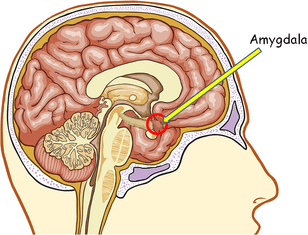
There is a structure in the human brain called the amygdala. It is part of what is known as the limbic system. The amygdala is located in the temporal lobe of the brain – in close proximity to the brain stem.

_4755829
Source: brainmadesimple.com

There are some who refer to the amygdala as the fear center of the brain; it is considered by others to be the emotion-processing center of the brain. I like to consider the amygdala “mission control” or, maybe more accurately, a “strategic command center.”


It is the amygdala that signals “Red Alert” in the brain. The amygdala is the emergency management system in the brain using to separate pathways of response. The amygdala is the initial, immediate, instantaneous response to anomaly.

There is also a data stream to the amygdala’s mission control that links through the sensory cortex of the brain. This secondary data stream provides the problem-solving associated with the “red alert.”

To give some context to how the amygdala processes and responds to the data that streams through it, let’s talk about a walk I took through a nature park near my home. It was a balmy late-summer day. Beautiful clear skies and roughly eighty degrees – it was a perfect day for a walk on the asphalt path of the park.

As I was strolling through the path, enjoying the beauty of the gorgeous day, my attention suddenly snapped to an object that had been laying on the edge of the path as it began to stretch itself out across the width of the path.   My immediate reaction was to stop. It took a millisecond or two longer for my brain to grasp that it wasn’t a stick that was moving, it was a snake! I took an instinctive step backwards away from the snake as I was observing how long it was before I remembered that I live in a part of the world where few poisonous snakes are found outside zoos and pet stores. I then took a step closer to see if I could capture a picture of the reptile with my cellphone because I didn’t recall that garter snakes could grow to three feet in length.

My amygdala was responsible for the immediate snap of my attention to the unexpected movement on the side of the path, the immediate stop and my step backwards: Whoa – stop – safe distance!

The curiosity and inquisitive action that occurred once my initial startle had passed reflected that my amygdala had moved from the immediate “survival” response into processing through the sensory cortex which transformed my initial surprise into an investigative process. “What is that?”

Another good example of this blended pathway of sensory processing would be an adult’s response to a loud noise. An explosion occurs, your amygdala has you “jumping” and turning your head in the direction of the sound before your eyes, ears, and nose are reporting that the car next to you backfired.

The amygdala generates the “Houston, we have a problem” response. The sensory cortex pathway brings forth the investigative team: what was that? What direction did it come from? Have we seen this before? Who is involved? Etc.

All incoming stimulus – visual, auditory, tactile, spatial – is processed through the amygdala. There is a constant stream of data flowing through – even when you are not conscious of it. In all truth, the amygdala is reviewing this stream of data particularly when you are not conscious of it.

Is anyone reading this asking themselves why I would be including this information in a blog about addiction and recovery?  I’d love to hear your thoughts…